Pandemic Walks: Assessing Boston's Civil War Narratives, Part I
by Kathleen Stone
June 14, 2021
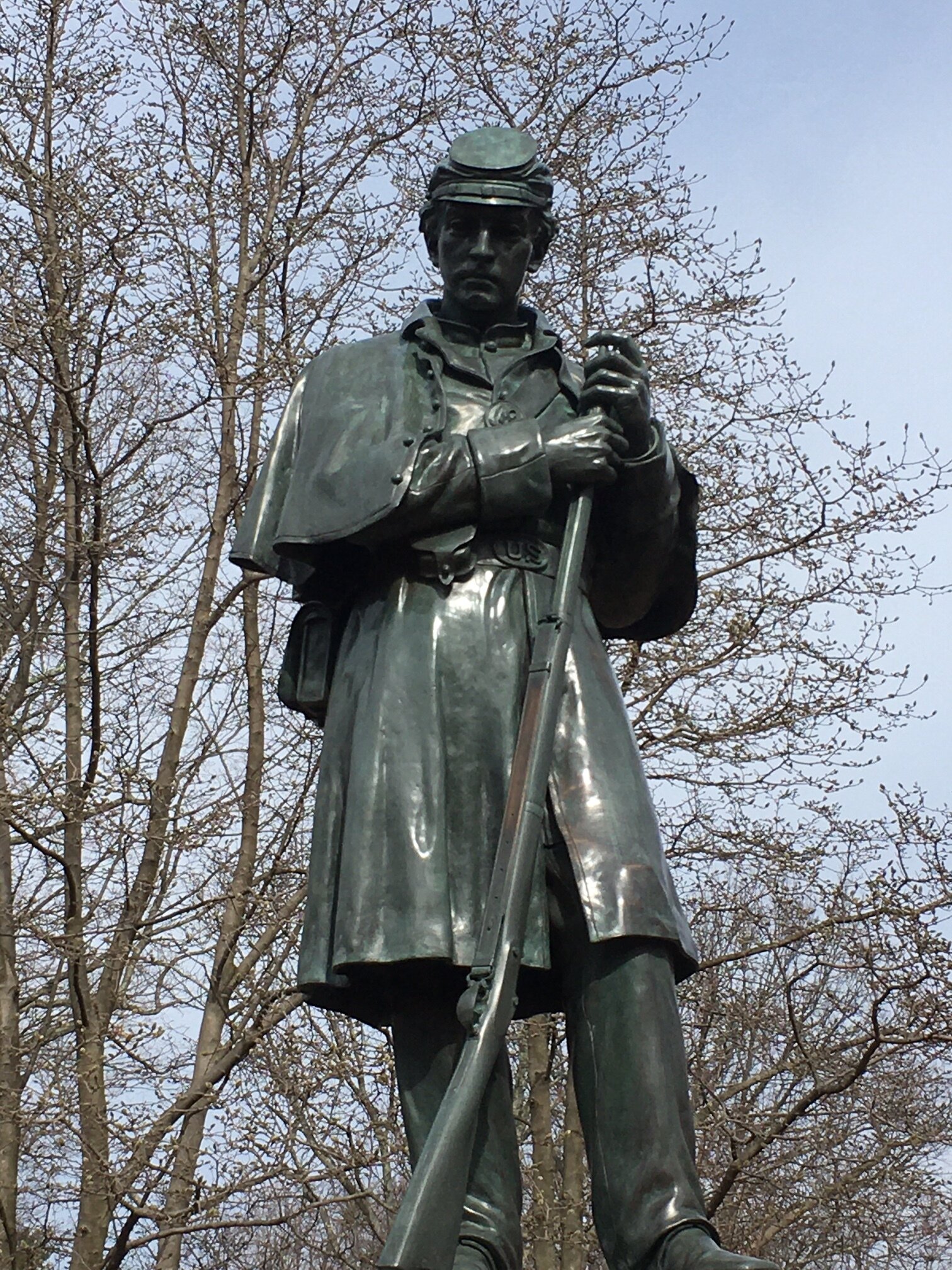
Roxbury Soldiers' Monument | Photo by the author
During the pandemic, my husband and I walked all over Boston, slowly and more attentively than before. We took time to notice what we had overlooked for years. On a walk through Forest Hills Cemetery, I saw the Roxbury Soldiers' Monument, not for the first time. I was transfixed.
A bronze soldier stands in the center of a small plot that measures 40 paces a side, by my rough estimate. Names of Civil War dead are inscribed on granite slabs that enclose the plot. The soldier, a rifle at his side, looks down, his face reflecting the grim knowledge that his comrades have fallen. His uniform is standard issue, but he is very much an individual, defined by a slightly cleft chin, high cheek bones, widespread nose, and a wave of hair under his cap. The details are so particular that I imagine the sculptor, Martin Milmore, asked a friend to pose.
Milmore's sculpture departs from the equestrian and Baroque-inspired styles more common in the era. His soldier stands alone, without any kind of flourish. He could be on the battlefield, gazing at fresh earthen mounds. Instead, I think he has come home to mourn the loss of neighbors. The grief on his face is as sharp today as it was then. Yet there is resignation too. Secession could not be allowed to stand; death was the necessary price.
Read the full article with a Literary Boston subscription.
