Two Days, One Hundred Poets, Countless Voices: The Boston Poetry Marathon Returns
by Jessica A. Kent | August 5, 2026
For nearly thirty years, the Boston Poetry Marathon has offered something increasingly rare: two days devoted simply to listening to one another's words.
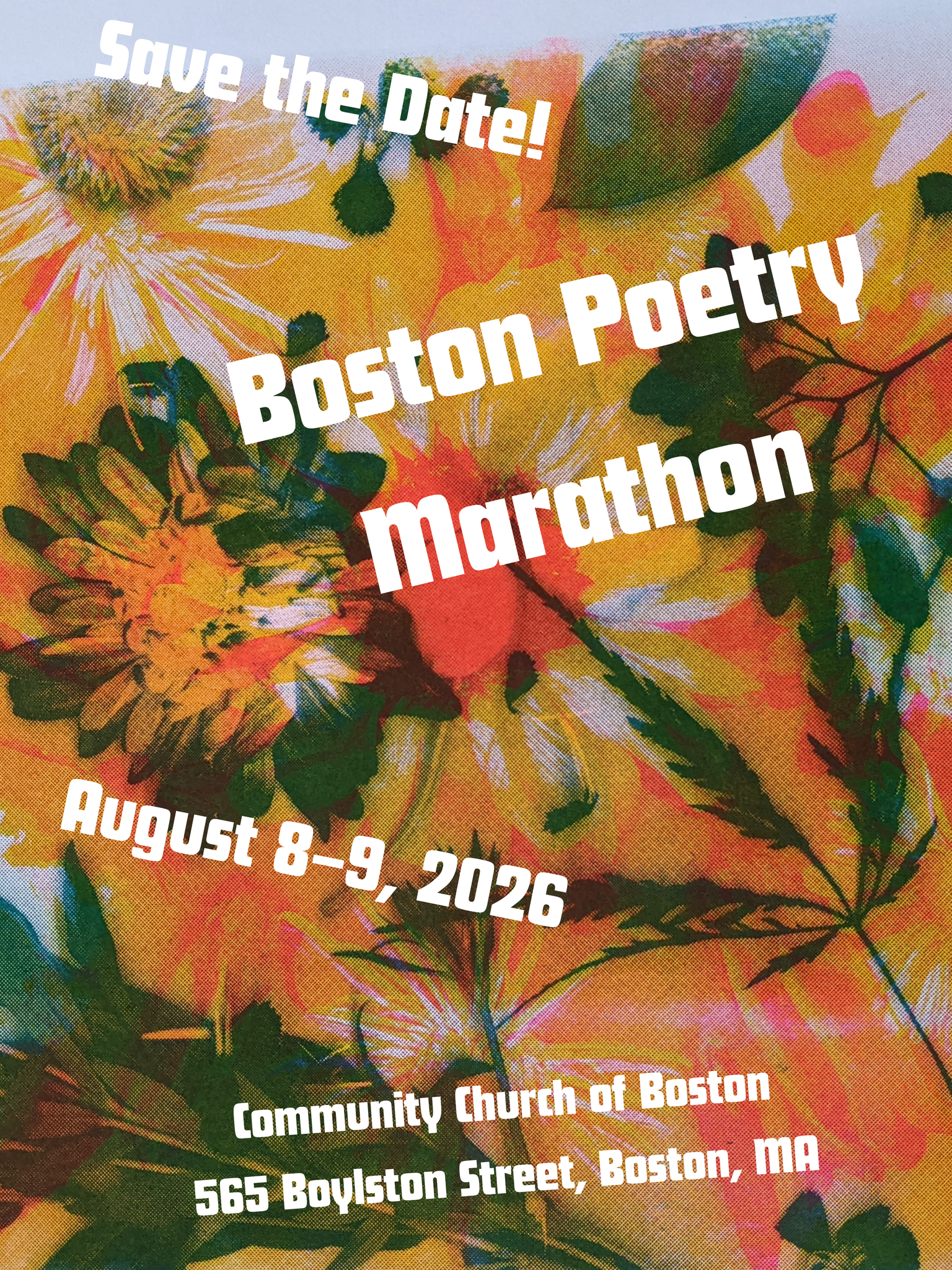
The Boston Poetry Marathon returns on Saturday, August 8 and Sunday, August 9 to the Community Church of Boston in Copley Square. Launched in 1998, the Boston Poetry Marathon gives readers seven minutes to share their poetry, and the 2026 event anticipates hosting over 100 poets — 63 readers on Saturday and 42 readers on Sunday — to read their work in the heart of the city.
I spoke with organizers Christina Liu, Chad Parenteau, and Xtina Strong about the Marathon's nearly thirty-year history, what to expect this weekend, and why creating spaces devoted to poetry still matters.
Origins of the Boston Poetry Marathon
The Boston Poetry Marathon was founded in 1998 as the “The Boston Alternative Poetry Conference” by Aaron Kiely, with help from Sean Cole. In an interview on the Boston Poetry Marathon website, Kiely said that he created the festival because he “wasn’t seeing any of the poets I was reading in the anthologies coming to Boston. So I decided to invite them.” The first year was held at the Cambridge Center for Adult Education and featured readings, poetry panels, book sales, and other features, with attendees coming from all over the country.
The next year they dropped the “Alternative” and held The Boston Poetry Conference at the Art Institute in Kenmore Square, and the third year festival organization was passed to Joseph Lease, Donna De La Perriere, and Jim Behrle. Back then the Boston poetry scene was full of reading series — some still going today, like Stone Soup Poetry, but many now defunct — as well as gatherings around various poetry zines and anthologies, some simply printed, stapled, and sold at readings.
“I knew it as the Boston Poetry Massacre when I first was invited to take part back in 2003. It's had too many other names to mention,” remembered Parenteau: “I loved those early readings. I saw a direct correlation between that and what Jim brought together with a lot of the people who were in the zines. ... It was such a smorgasbord.”
Strong explains how the smorgasbord was made up of whoever wanted to come and read. “We weren't exactly affiliated with any of the schools, which is part of the whole reason why it was more anarchistic. We weren't affiliated with BU or any of those sorts. We also had other people coming from out of town, like Philly and New York and Western Mass. So it's not strictly all Boston poets. We also wanted to reach out to the schools in Western Mass and elsewhere, and just friends of ours.”
The Boston Poetry Marathon has also attempted to be a space open to all types of poetry, from all walks of life. Parenteau and Liu recall the clash over “page or stage,” and the anti-slam movement and other factions that tended to divide the poetry community. All the more need for a place where everyone was welcome.
“Not everyone fits into one niche,” said Parenteau. “Let's come together and enjoy as many voices as possible, and people you would normally never run into. It was amazing. It was in 2003 when I first heard the poem by John Mulrooney, ‘If you see something, say something,’ which was a broadside from Anchorite Press that was put out over two decades ago. And it was just stunning poems like this that you couldn't get anywhere else.”
Liu doesn’t remember which side of any of the schisms she fit on, “but I definitely feel welcome. Especially for poets who maybe feel like they're neither with the academic scene, nor the slam poetry scene, nor any faction of poetry. And I think that's really important, that feeling of inclusion.” And so is representation. “As a much younger person decades ago, but I would have loved to see more diversity [at poetry events]. Diversity in race, in age, in socio-economic background, in education. … I still think that that representation is super important. It's really important for all of us as writers and poets to look on a meta level outside of our immediate circle, myself included,” said Liu.
But poetry gatherings like this today are facing challenges in a tech-filled, post-COVID world. There’s value in meeting in-person versus online (which they did during COVID) and engaging in real life with the reader and work in front of you. But when Zoom and other online spaces give someone access to anywhere in the world, they may be less willing to travel from out of state, as the organizers encountered when inviting poets to this year’s Marathon. Another challenge is bringing in younger poets to not only participate but to lead when many aren’t staying in Boston because many can’t afford to stay.
Still, the Boston Poetry Marathon is committed to keeping live readings alive by creating a thriving annual event where poets can come together to connect, hear great work, and find community.
This Year’s Marathon, Start to Finish
The Boston Poetry Marathon moved locations over the years, including a stint at Outpost 186, and now has its home at the Community Church of Boston in Copley Square — which has air conditioning, something past venues did not have for a Summer poetry marathon. Today, the Boston Poetry Marathon features seven-minute reading slots for any poets who want to participate, regardless of publishing credits, affiliation, or location.
“People have books out or chapbooks, or maybe they don't have a book yet. It’s helpful that you have read your poetry before, because you do have seven minutes, so you have to be focused,” said Strong. “There's been a whole bunch of people that we've had. Harvard people, to Emerson, to Tufts, to now slam poets.”
“I made an effort to bring in younger readers or readers who may not have heard of the Boston Poetry Marathon, much like myself a few years ago,” said Liu. “Last year we had the Massachusetts Poet Laureate Regie Gibson, and this year we have two Brockton Poet Laureates. So we try to have different voices, and not in terms of the demographics one would think of, but socioeconomically, just from all different walks of life.”
“The North Shore poets will definitely represent,” said Parenteau. “People like January Gill O'Neil, and M.P. Carver and Clay Ventre, who do amazing work on a local level in Salem. These are people who definitely bring their own youth movement, as younger poets and teachers of others, they do an amazing job with that. I hope that more groups come down from the north or south or wherever they come from to offer that kind of energy as well in the future.”
The Boston Poetry Marathon also features time dedicated to poets lost the previous year, and this year they anticipate words spoken for Charles Coe, Jennifer Martelli, and Danielle Legros Georges.
Because of the community it has built up, the Marathon has a slate of returning poets years after year, given first reservations at time slots. But given the over one hundred slots available, it seems that if you want to apply to read, you probably can. While there’s no official open mic, empty slots are assigned to Emily Dickinson, who famously never appears for her time, so if you show up to read you might be able to fit in.
What is the experience in the room like, hearing all these poets read one after another? “Lot of emotional impact, a lot of pathos, a lot of humanity,” said Liu. “I had a friend come in for about two hours, and he said, ‘I have to take a break. I have to leave. This is just all too much emotionally.’ And I can attest to that. Being there for a day, two days — it’s so much osmosis of lived experiences, of joy, of pain, all that good stuff that makes us human.”
There will also be chances to meet other poets and writers, chat about work, and make new connections in the community. And that’s the role that the organizers hope the Boston Poetry Marathon will play, though building community and connection in a broader, more deliberate sense wasn’t necessarily top-of-mind. It’s much simpler:
“I'm around my friends, and I get to read poetry or hear it, and then they get to hear mine, and we all like each other. ... People hang out, start meeting new people that you have the same interests with, and hear good poetry that you've been wanting to hear for a long time that you didn't know that you needed to hear,” said Strong. “Like Christina said, it does get emotional, but also gets intellectual. People recommend books. There's just so much. What we get out of it is what we want you to get out of it, or else we wouldn't be doing it.”
The Boston Poetry Marathon runs from 11:00am to 10:00pm on Saturday, August 8, and from 11:00am to 5:00pm on Sunday, August 9. Learn more about the Boston Poetry Marathon and view the 2026 schedule here.